
HYROX Nutrition Plan: 2 Days Out to Race Day
Quick Overview
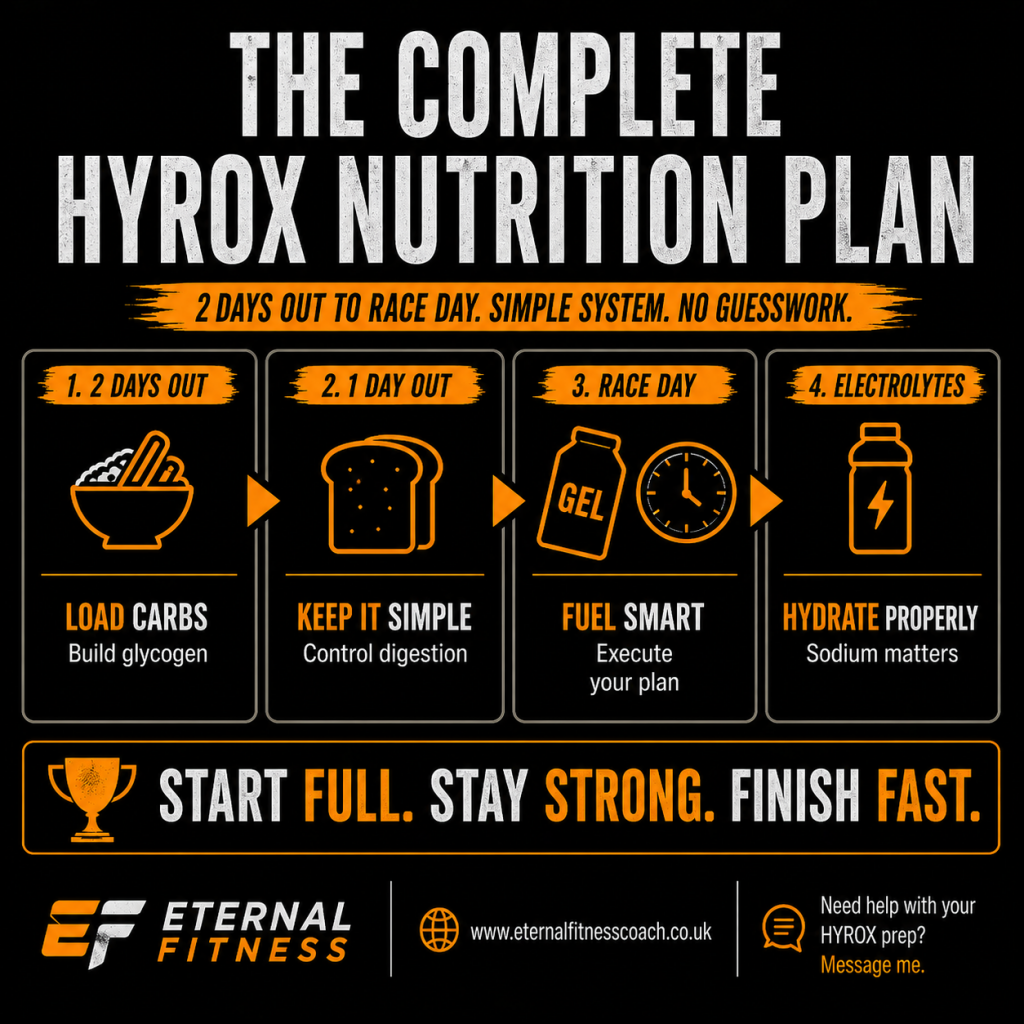
This guide breaks down exactly how to fuel in the final 48 hours so you don’t fade mid-race.
You’ll follow a simple structure:
- 2 days out: build glycogen stores properly
- 1 day out: keep digestion controlled and predictable
- race day: fuel and hydrate with a clear plan
- electrolytes: manage sodium so hydration actually works
Just a simple system you can follow so you start confident, hold your pace, and finish strong!
HOW HYROX FUELING ACTUALLY WORKS
To master HYROX, you must manage two critical internal systems: Energy and Hydration. When these systems fail, your performance will have a serious dip.
The Energy System: Glycogen
Unlike a steady state jog, HYROX is a series of physiological “spikes.” You transition from running to high resistance movements (like the Sled Push or Burpees), forcing your heart rate into the red zone. In these high intensity windows, your body relies almost exclusively on glycogen (stored carbohydrates in your muscles and liver).
The Preparation Rule: You cannot “build” glycogen on the morning of the race. You must arrive with your tanks already saturated.
The “Wall”: If your stores are low, you won’t feel it at the finish line; you’ll feel it by Kilometre 4. That “flat” sensation in your legs isn’t always a lack of training; it’s often a literal lack of fuel.
The Hydration System: Fluid Retention
Most athletes misunderstand hydration. The goal isn’t simply to drink water; it’s to retain fluid so your blood volume stays high and your muscles can fire.
The Sodium Factor: Sodium is the “sponge” that holds water in your system. Without adequate salt, drinking more water simply dilutes your blood, leading to frequent bathroom breaks, cramping, and a drop in power.
The Dilution Trap: Drinking plain water during a high sweat event can lead to hyponatremia (low blood sodium), making you feel sluggish and heavy.
THE “INTENSITY GAP”
HYROX presents a unique challenge: it is too intense for your body to digest complex meals mid-race, but long enough that poor preparation will be exposed. Once the clock starts, your blood moves away from your stomach to your working muscles, making digestion nearly impossible.
The Strategy is Simple:
Front-Load: Maximize energy stores 48 hours out.
Settle: Ensure the gut is calm and clear of fiber.
Top-Off: Use small, rapid-access fuel sources just before the start.
Minimalism: Avoid overloading the stomach during the race to prevent “sloshing” or nausea.
Fueling isn’t about consuming more; it’s about the precise timing of intake so your body remains a closed, efficient system when the intensity peaks.
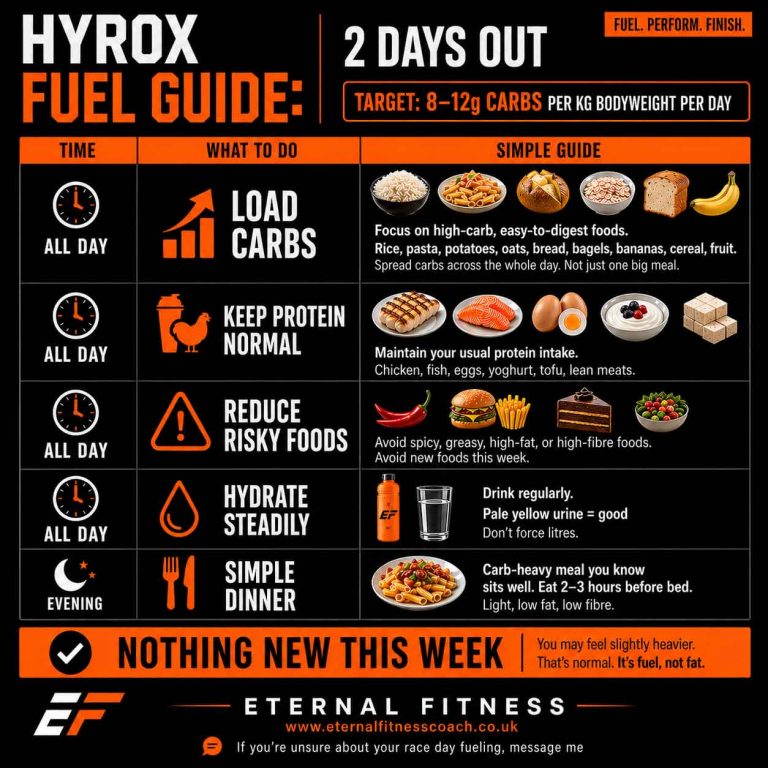
2 DAYS OUT: START YOUR CARB LOAD
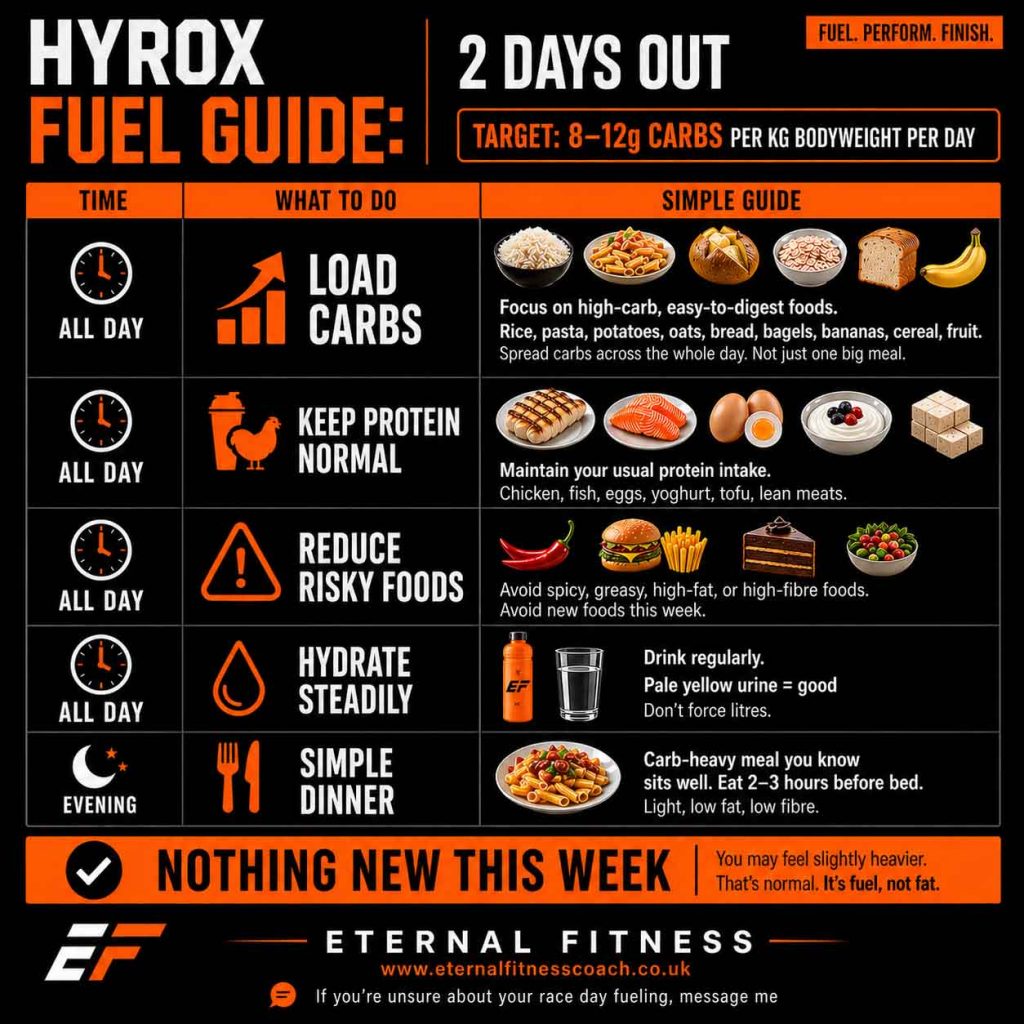
The race doesn’t start in the starting corral; it starts here.
This 48-hour window has one objective: Saturating your glycogen stores. Most athletes underestimate the sheer volume of fuel required to be fully “loaded.” Adding a side of pasta or an extra bagel isn’t enough—if you want to maintain your running pace after the heavy sled pulls, you must be intentional.
THE TARGET: 8–12g OF CARBS PER KG
To calculate your daily requirement, multiply your body weight in kilograms by 8 to 12. For a 75kg athlete, that is roughly 600g to 900g of carbohydrates in a single day.
This volume is impossible to hit in one “big meal.” It requires a consistent, day-long approach using high-yield, familiar fuel sources:
Grains: Rice, pasta, bagels, and bread.
Starches: Potatoes, sweet potatoes, and oats.
Fruits: Bananas and dried fruits.
THE LOADING BLUEPRINT
To avoid the “food coma” or gastric distress, follow these three rules:
Micro-Feeding: Spread your intake across breakfast, lunch, and dinner, with 2–3 high-carb snacks in between.
The Fiber Fade: You can tolerate fiber (whole grains, veg) early in the day. As evening approaches, switch to “white” or simple carbs (white rice, white bread) to begin easing the load on your digestive system.
Supportive Macros: Keep protein intake at your normal baseline. Maintain moderate fat—excessive fat will slow down digestion and make hitting your carb targets much harder.
HYDRATION & THE “GLYCOGEN WEIGHT”
Hydration isn’t just about drinking water; it’s a chemical requirement for storage. For every 1g of glycogen stored in your muscles, your body pulls in approximately 3g of water.
Note: Do not be alarmed if the scale goes up slightly by the end of the day. This “weight” is not body fat—it is the literal weight of the fuel and water your muscles will use to produce power on race day.
THE SODIUM CONNECTION
Ensure you are salting your meals or adding an electrolyte supplement today. Sodium acts as the transport mechanism that helps your body shuttle those carbohydrates into the muscle cells and hold the necessary fluid. We will discuss more of this further down this post..
Don’t wing it. Hit your numbers today so you have a physiological foundation to build on tomorrow.
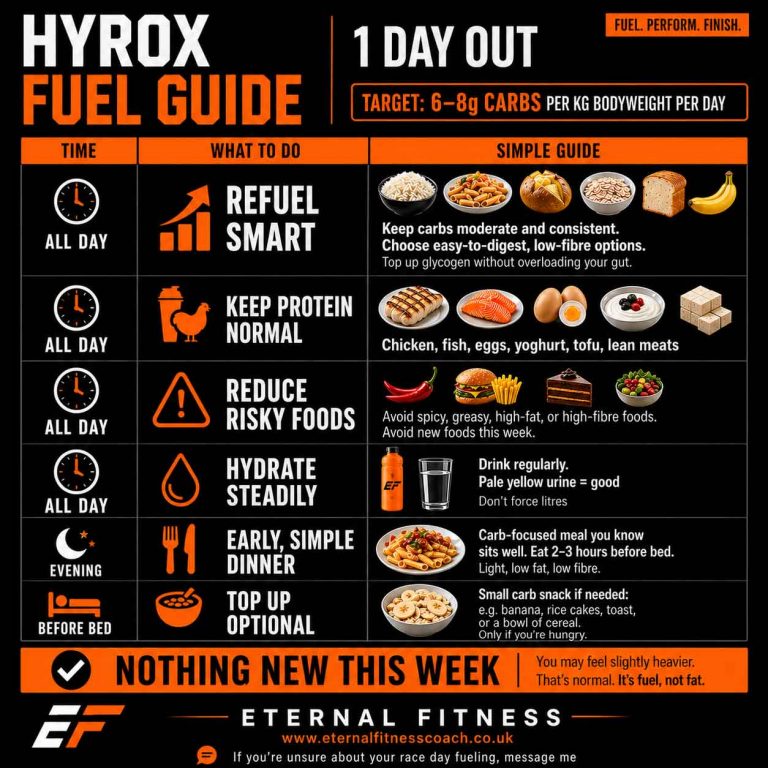
1 DAY OUT: STABILITY OVER VOLUME
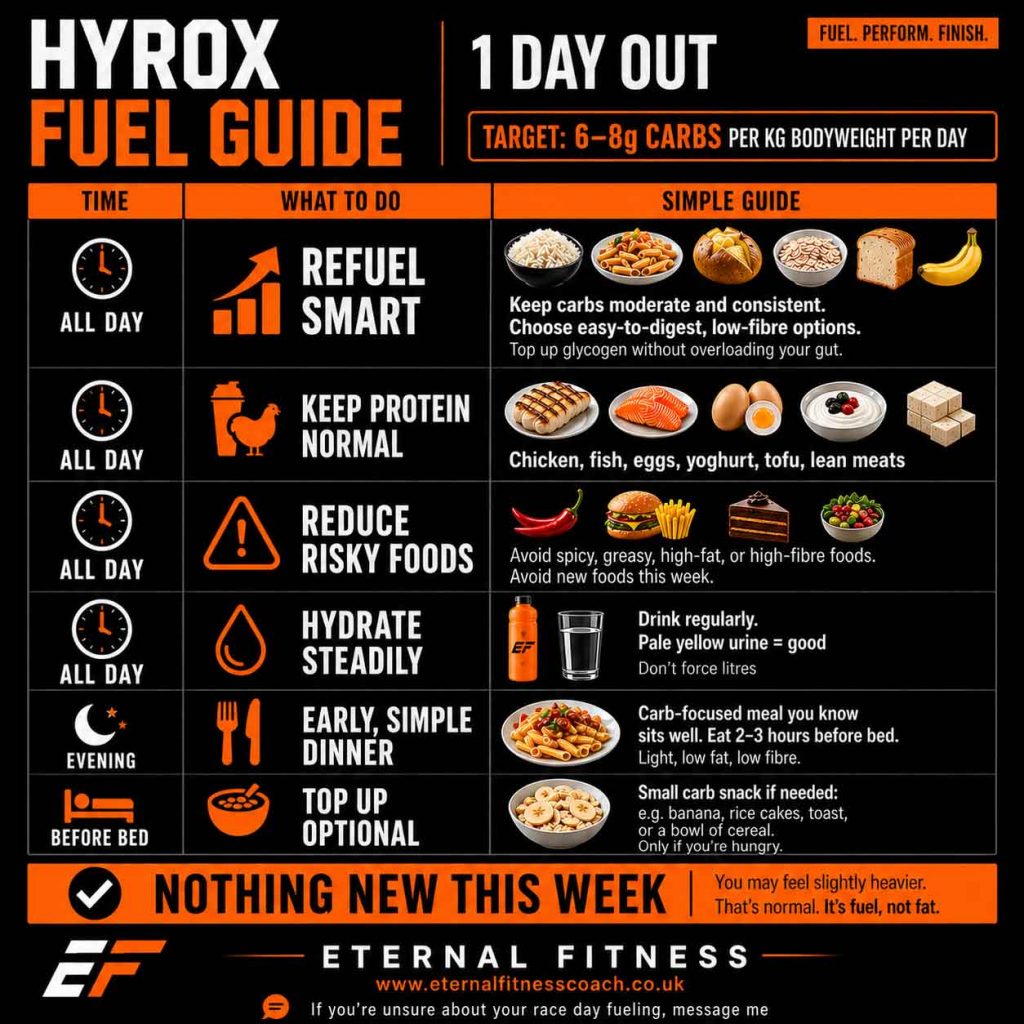
This is the phase where many athletes over-correct. After a heavy loading day, the temptation is to keep pushing, but the heavy lifting is already done. Your glycogen stores should be nearly capped.
Today’s objective is simple: Maintenance and Digestive Peace.
THE ADJUSTED TARGET: 6–8g OF CARBS PER KG
You are still fueling, but you are tapering the volume slightly to avoid feeling sluggish. For a 75kg athlete, this looks like 450g to 600g of carbohydrates.
The focus shifts from quantity to quality of digestion. You want to enter race morning feeling “light” but energized, not heavy and bloated.
THE “LOW-RESIDUE” SHIFT
Fiber is your enemy today. While usually healthy, fiber adds bulk to your stool and slows down gastric emptying. On race day, you want your digestive tract as clear as possible to avoid unwanted pit stops or “gut rot” during the runs.
Prioritize “White” Carbs:
White Rice or Pasta: Easier to process than whole-wheat versions.
Plain Bagels: High carb density with minimal fiber.
Simple Cereals: Think Cornflakes or Rice Krispies.
Avoid: Large salads, cruciferous vegetables (broccoli/cauliflower), and heavy beans.
PRECISION HYDRATION
Don’t wait until you’re thirsty. Sip consistently throughout the day to ensure every cell is fully hydrated.
Sodium is Non-Negotiable: Plain water can flush out your system today, leaving you “flat” tomorrow. Use electrolyte tabs or salt your food. The goal is to hold that fluid in your muscle tissue.
Urine Check: Aim for a “straw-colored” output. If it’s crystal clear, you may be over-drinking; if it’s dark, you’re behind.
THE “BORING” DINNER RULE
Your final meal before race day should be the most unremarkable meal of your life.
No New Foods: This is not the time for a new restaurant or a “special” ingredient.
Keep it Simple: A bowl of white rice with some lean chicken, or a plain plate of pasta.
Limit Fat/Spice: Avoid heavy sauces or spicy seasonings that could cause heartburn or morning-of distress.
Pro Tip: I’ve learned the hard way that “trying to be clever” the night before backfires. You aren’t looking for a
“secret super meal”. You’re looking for a safe one. Today, boring is a competitive advantage.
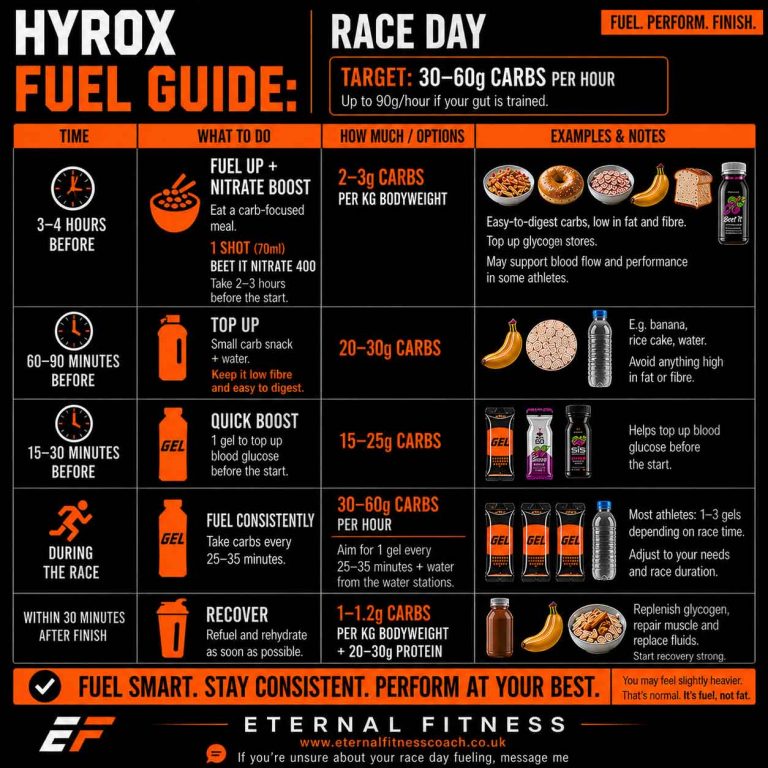
RACE DAY: EXECUTION, NOT GUESSWORK
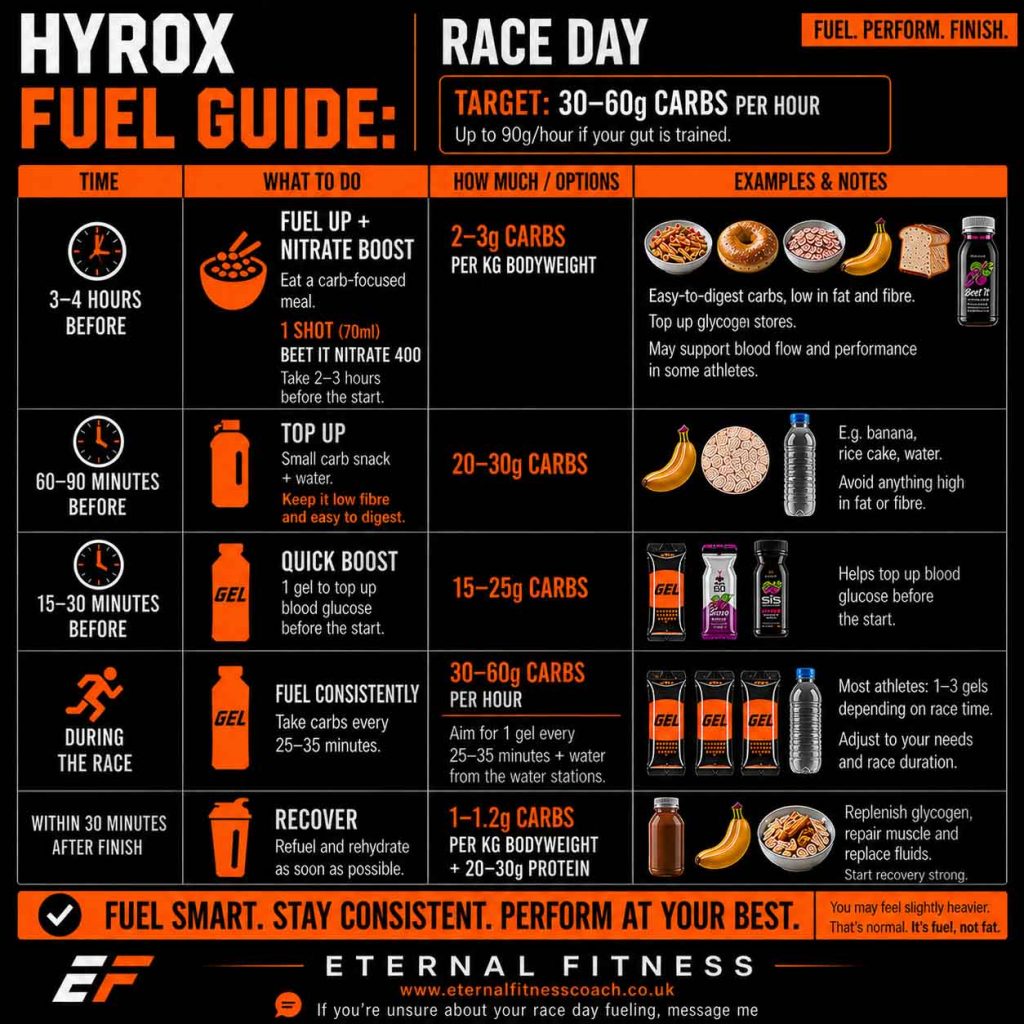
The time for experimentation is over. Today is purely about delivering the performance you’ve spent months building. Your focus is on maintaining blood glucose levels and ensuring your gut remains calm under extreme stress.
3–4 HOURS BEFORE: THE ANCHOR MEAL
Eat a substantial, carb-heavy meal to top off your liver glycogen after a night of sleep.
The Goal: ~2–3g of carbs per kg of bodyweight.
The Menu: Plain bagels with jam/honey, white rice, or a banana.
The Rule: Keep fiber and fat near zero. You want this fuel processed and moved out of your stomach well before the start whistle.
2–3 HOURS BEFORE: THE SODIUM PRELOAD
This is your most critical hydration window.
The Action: Consume a high-concentration electrolyte drink (aim for 500–1,000mg of sodium).
The Why: This “expands” your blood volume, helping your heart pump more efficiently and delaying the onset of fatigue. If you only drink plain water now, you risk starting the race with a salt deficit.
THE PERFORMANCE ADD-ON (OPTIONAL)
If you’ve tested it in training, this is where nitrate supplementation can give you a small edge.
The Action: Take 1 shot (70ml) of Beet It Sport Nitrate 400.
The Why: Dietary nitrates can support blood flow, reduce oxygen cost during high-intensity work, and improve efficiency under fatigue. In a race like HYROX, where output stays high from start to finish, even a small improvement in efficiency can make a difference.
The Rule: This is not essential. It only works if:
- you’ve used it before
- your stomach tolerates it
- you take it 2–3 hours before the start
If you haven’t tested it, skip it. You can get it HERE
60–90 MINUTES BEFORE: THE TOP-UP
Keep your metabolism ticking over without weighing yourself down.
The Action: 20–30g of simple carbs.
The Options: A small banana, a rice cake, or a few pretzels. Drink a few sips of fluid to assist with gastric emptying.
15–30 MINUTES BEFORE: THE START-LINE GEL
Take one final gel just before you enter the starting pen.
The Benefit: This raises your blood glucose levels right as you enter the first run. It provides an immediate fuel source so your body doesn’t have to tap into deep muscle stores during the first two stations.
DURING THE RACE: THE MINIMALIST PROTOCOL
HYROX is too intense for a buffet. Between the heavy breathing and the physical demand of the stations, your digestive system is essentially “closed.” Keep your intake surgical.
| Component | Target | Execution |
| Carbohydrates | 30–60g per hour | 1 gel every 25–35 minutes (usually 1–3 gels total). |
| Hydration | Sip to thirst | Take small sips of water at the stations to rinse your mouth and stay hydrated. |
THE REALITY OF THE GAUNTLET
In the heat of competition, when your heart rate is at 90%+ and you’re transitioning from a 1km run to a 50m Sled Push, you will not have the mental capacity to “figure it out.”
Everything should be automatic:
You know exactly which pocket your gels are in.
You know exactly which water stations you will hit.
You have practiced this exact timing in your heavy training sessions.
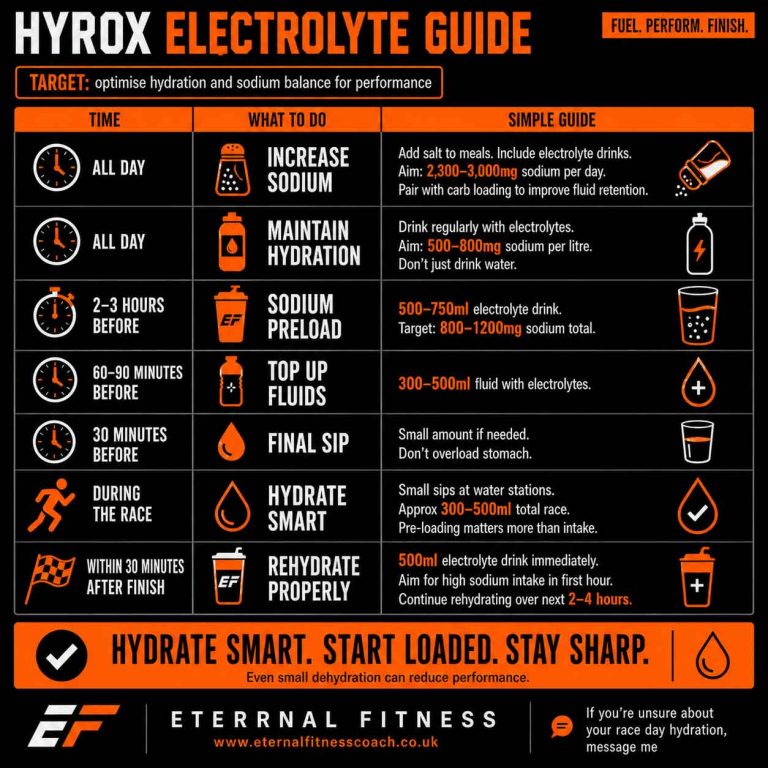
ELECTROLYTES: THE MISSING PIECE
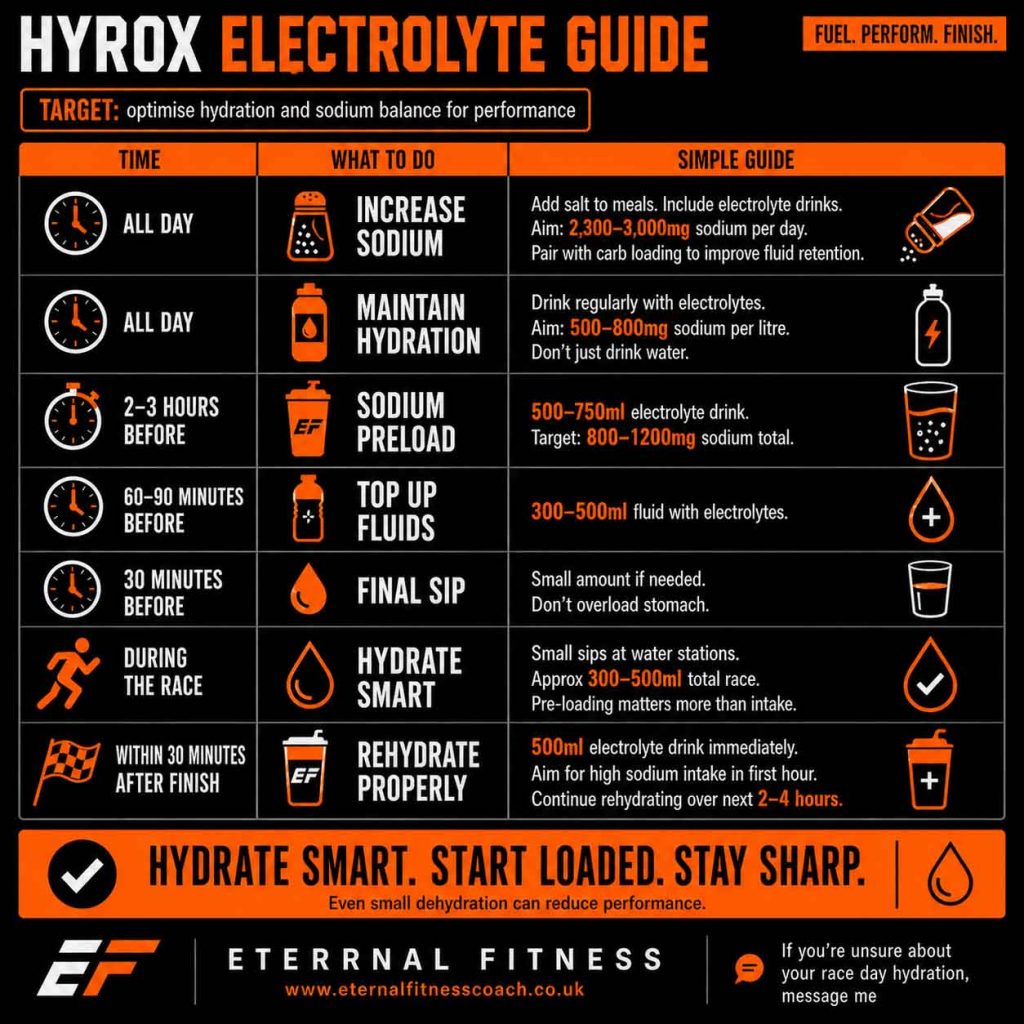
Many athletes believe they are hydrated simply because they carry a water bottle. In reality, they are often “diluted” rather than hydrated. If you drink excessive water without electrolytes, you might show up to the start line feeling heavy, crampy, or physically “flat.”
The problem is simple: Hydration is a partnership between fluid and sodium.
THE SODIUM DEFICIT
Sodium is the primary electrolyte lost in sweat, and its role is to regulate blood volume and fluid retention.
The Fluid Trap: Without enough sodium, your body cannot hold onto the water you drink. Instead of hydrating your muscles, the water passes straight through your system, leading to frequent bathroom breaks and a drop in performance.
The “Flat” Feeling: When blood volume drops due to poor sodium balance, your heart has to work harder to pump oxygen to your muscles. That lack of “pop” or “sharpness” in your legs during the runs is often a direct result of low sodium.
WHY HYROX IS DIFFERENT
HYROX is a high-intensity indoor environment. Because of the humidity and the constant transitions, you sweat more than you realize. Unlike a marathon, there is no rhythm to your drinking; you are often gasping for air or moving heavy objects, making it difficult to consume fluids during the race.
If you don’t start the race in a surplus, you will spend the entire event playing catch-up.
THE PRE-LOADING PROTOCOL
Since you cannot rely on mid-race hydration, you must shift your focus to the 48 hours leading up to the event:
| Timeline | Action |
| 48 Hours Out | Increase salt on your meals. Begin adding a basic electrolyte tab to your water. |
| 24 Hours Out | Ensure every liter of water you drink contains electrolytes. Avoid plain water. |
| Race Morning | The Preload: Consume 500–1,000mg of sodium in the 2–3 hours before your start time. |
RED FLAGS: HOW TO TELL IF YOU’RE “OFF”
If your electrolyte balance is poor, you will notice these symptoms early in the race:
Unexplained Fatigue: Feeling exhausted by the second run, despite a slow pace.
Muscle Heaviness: Your legs feel like lead during the Sled Push or Lunges.
Brain Fog: Difficulty focusing on station counts or lap times.
Cramping: Involuntary twitches or full-blown muscle knots.
SUMMARY FOR SUCCESS
You don’t need a degree in chemistry to get this right. Just follow these three rules:
Water alone is never enough. It must have sodium to be functional.
Pre-loading is king. What you do the night before and the morning of matters more than what you do at the water stations.
Recover with salt. Post-race, replace your losses with a high-sodium drink to kickstart recovery and avoid the post-race “hangover.”
Hydration isn’t a thirst response; it’s a performance strategy. Get it right, and the race feels manageable. Get it wrong, and you’re fighting your own physiology.
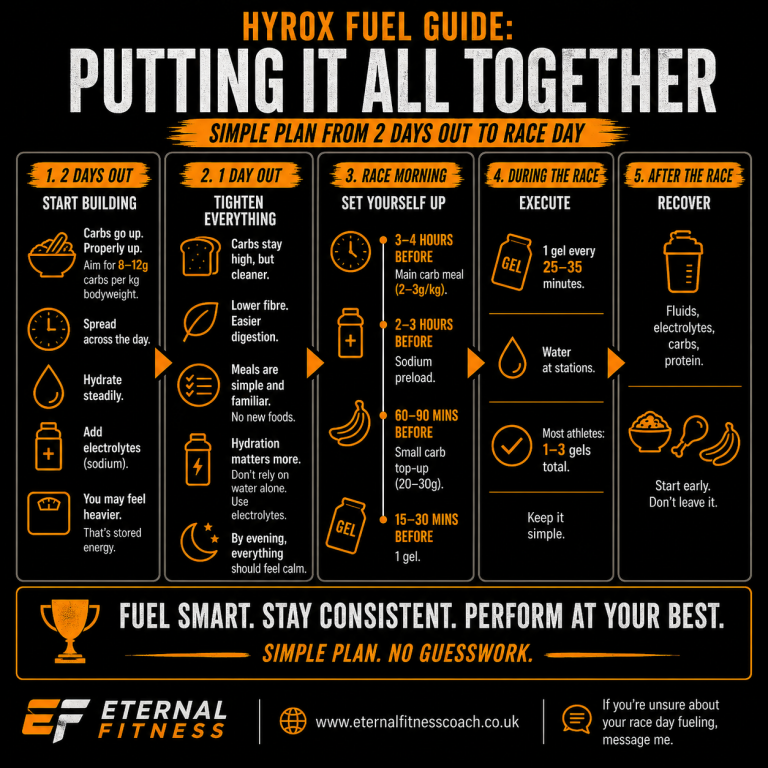
PUTTING IT ALL TOGETHER (SIMPLE PLAN)
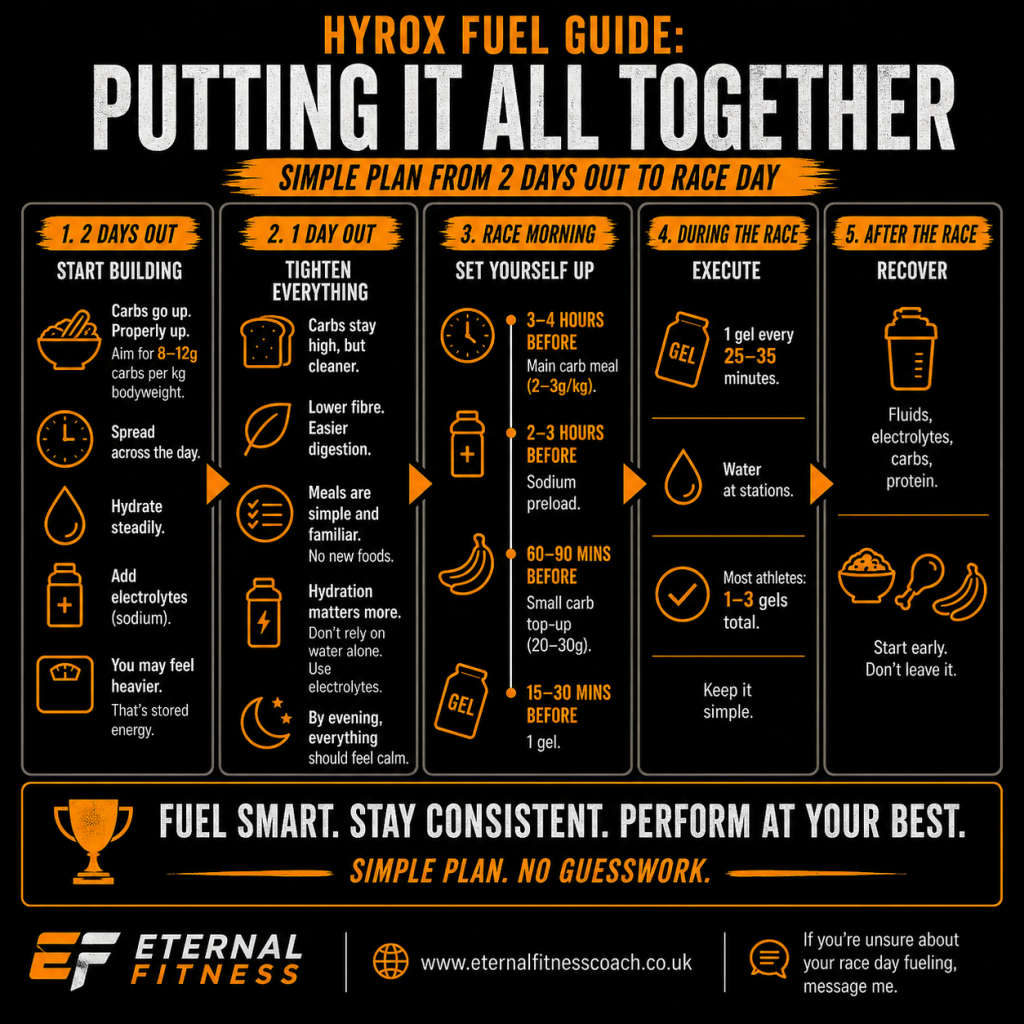
Keep this simple. You don’t need to think on race week. You just follow the structure.
2 days out
Start building.
Carbs go up. Spread across the day. Not one big meal.
Eat simple foods you tolerate. Hydrate steadily. Add some sodium.
You might feel heavier. That’s fine. That’s stored energy.
1 day out
Tighten everything.
Carbs stay high, but cleaner. Lower fibre. Easier digestion.
Meals are simple. Familiar. No experimenting.
Hydration matters more here. Don’t rely on water alone. Use electrolytes.
By the evening, everything should feel calm.
Race morning
Set yourself up.
3–4 hours before.
Eat your main meal. Carb-focused. Low fat. Low fibre.
2–3 hours before.
Sodium preload. Help your body hold fluid.
60–90 minutes before.
Small carb top-up.
15–30 minutes before.
Take a gel.
Nothing rushed. Nothing forced.
During the race
Execute.
1 gel every 25–35 minutes.
Water at stations.
Most people will take 1–3 gels total.
That’s enough.
After the race
Recover properly.
Fluids. Electrolytes. Carbs. Protein.
Start early. Don’t leave it.
That’s the whole system
No complicated rules. No last-minute decisions.
You build energy. Control digestion. Preload hydration. Then execute.
Do this right, and you remove a major variable from your race.
You still have to perform. But you won’t be fighting your own fueling.
THE "PERFORMANCE KILLERS": COMMON FUELING MISTAKES
In HYROX, small nutritional errors are magnified by the sheer intensity of the event. These pitfalls often seem logical at the time, but they are the primary reasons athletes “blow up” mid-race.
1. THE “FAKE” CARB LOAD
This is the most frequent error. Many athletes believe a large bowl of pasta the night before constitutes a carb load.
The Reality: One meal cannot saturate your glycogen stores. It requires 48 hours of consistent, high-volume intake.
The Consequence: If you start with half-empty tanks, you won’t hit a wall at the end; you’ll hit it at the halfway mark. Your legs will feel heavy, and your pace will drop without a clear physical explanation.
2. PRIORITIZING “HEALTH” OVER PERFORMANCE
Normally, high-fiber, complex carbohydrates are the gold standard. On race eve, they are a liability.
The Reality: Fiber slows down digestion and adds bulk to your digestive tract.
The Consequence: High fiber intake in the final 24 hours leads to bloating, “heavy” stomach sensations, and mid-race bathroom emergencies. Switch to “simple” white grains to keep your gut light and efficient.
3. THE WATER DILUTION TRAP
Drinking liters of plain water in the lead-up to the race is often counterproductive.
The Reality: Hydration is a balance of fluid and sodium.
The Consequence: Without electrolytes, you aren’t hydrating your cells; you are simply diluting your blood sodium levels. This leads to a “flat” feeling, reduced power output, and potential cramping.
4. LAST-MINUTE EXPERIMENTATION
The “Race Expo” trap: buying a new brand of gel or a “miracle” supplement the day before you compete.
The Reality: Your digestive system is highly sensitive under stress.
The Consequence: Introducing a new ingredient can cause immediate gastric distress or nausea. If you haven’t used it in training, do not use it on the course. Stick to the boring and the familiar.
5. MID-RACE OVERLOAD
Some athletes try to compensate for poor preparation by consuming too much during the race.
The Reality: HYROX intensity is so high that blood is diverted away from the stomach to the working muscles. Your ability to digest is severely compromised.
The Consequence: Taking in too many gels or too much fluid leads to “sloshing,” side stitches, and nausea. Aim for the minimum effective dose (1–3 gels total) rather than trying to eat your way through the pain.
6. REACTIVE VS. PROACTIVE PLANNING
Trying to “fix” your energy levels or hydration during the race is a losing battle.
The Reality: By the time you feel thirsty or exhausted, it’s already too late to fully recover.
The Consequence: Improvisation under a heart rate of 180 bpm leads to poor decisions.
The Takeaway: HYROX rewards the disciplined. By getting these six basics right, you remove the invisible barriers that quietly ruin performance. Don’t be the athlete who tries to be “clever” on race day. Be the one who is prepared.
FINAL THOUGHTS
This isn’t complicated.
It only looks that way when everything gets mixed together. Different opinions. Different strategies. Too many moving parts.
Strip it back and it’s simple.
Eat enough in the days before.
Keep your gut calm the day before.
Start the race fuelled and hydrated.
Make a few simple decisions during.
Then get it back in after.
That’s it.
You don’t need perfect numbers. You don’t need to overthink every detail. You just need a plan you trust and the discipline to stick to it.
I’ve gone into races overthinking this. Trying to tweak things late. Adding things I didn’t need. It never improved anything.
The races that felt best were the ones where nothing changed.
Same foods. Same timing. Same approach.
Everything just worked.
That’s the goal here.
Not to find the perfect strategy.
Just one that holds up when the race gets hard.
NEED HELP WITH YOUR HYROX PREP?
You’ve now got the structure.
The difference is in how you apply it.
Everyone’s slightly different:
- bodyweight
- race time
- gut tolerance
- how well they handle gels and fluids
That’s where things can still go wrong.
If you want this dialled in for you, not just generic guidance, I can help you put a simple plan together that actually fits how you train and race.
No guesswork. No last-minute changes. Just something you can follow with confidence on race week.
If you want this tailored to your race, pacing and current fitness, I’ll map it out for you. Message me directly